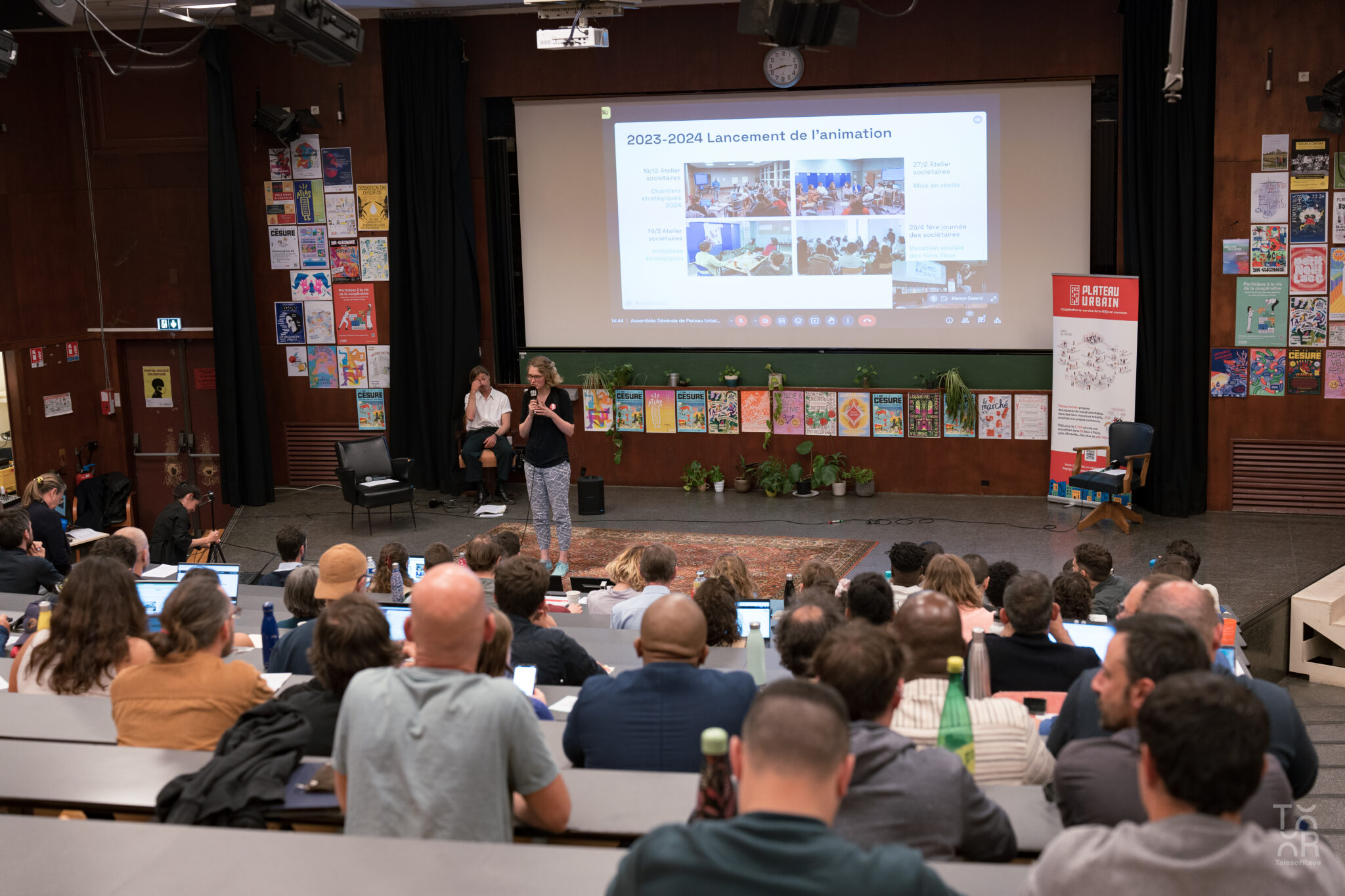
Raphaëlle Chaygneaud-Dupuy, who oversees cooperative operations and membership, discusses the reasons that led Plateau Urbain to choose the status of a Cooperative Society of Collective Interest (SCIC).
In 2013, an association was founded, quickly joined by a team of volunteers motivated by a shared vision: to increase the use of vacant buildings in the Île-de-France region. Quick to implement, well-recognized by the social sector, and flexible in its operations, the association was ideal for testing and experimenting with a new activity that was still taking shape.
Little by little, the project took shape as sites opened, and a building management model emerged thanks to owners willing to make their unused spaces available for activities and people often excluded from the heart of metropolitan areas. Employees joined the project, and the organization transformed. It was time to formalize the project under a new legal structure.
In 2017, the choice of a cooperative in the form of a cooperative society of collective interest (SCIC) consolidated the organization’s political vision, which now includes more than 20 employees. Three factors drove this decision: the desire to keep decision-making in the hands of operational staff (since in an association, a director cannot serve as president); the need to accommodate new activities, including for-profit ones, which the cooperative structure allows; and finally, the independence of the Plateau Urbain association from subsidies.
Plateau Urbain thus leaves the nonprofit sector to become a corporation, without, however, leaving the realm of the SSE. The acronym stands for the social and solidarity economy, which includes associations, foundations, mutuals, cooperatives, and social enterprises with commercial status (notably adapted enterprises and integration enterprises). The 2014 law on the SSE identified four commonalities uniting these structures.
However, behind these broad shared principles, the intentions of the founders of SSE structures can vary greatly. Some founders decide to create a company designed to hire people with disabilities, but are not at all motivated by limited profitability. Founders of social integration enterprises may be driven by the vision of a more inclusive society, without necessarily having shared governance within their structure. Cooperative founders may adhere to democratic and sharing principles without necessarily developing a product or service that is particularly beneficial for the planet or society. It is valuable to have a diversity of organizational models, allowing everyone to find a way to engage in their work that aligns with their values.
Beyond the initial choices regarding legal form, it is the salaried teams within these organizations that drive the deepening of the chosen course—that is, the societal mission established explicitly or implicitly (through all elements of an organization’s culture). Thus, in 2019, Plateau Urbain obtained ESUS accreditation (Entreprise Solidaire d’Utilité Sociale), a designation granted by the government under the 2014 law that adds two elements to the common principles of the Social and Solidarity Economy (SSE): “to pursue social utility as its primary objective, which must impact the organization’s profitability; and to have a regulated compensation policy.”
In 2017, Plateau Urbain thus became a cooperative society of collective interest. The cooperative form allows Plateau Urbain—a project at the crossroads of different worlds—to take shape as a hybrid legal entity: a non-profit enterprise with a social mission as its guiding principle and the pursuit of financial balance without subsidies. The choice of the SCIC, rather than the SCOP, reflects Plateau Urbain’s desire to serve as a meeting place and intermediary between actors operating in different fields of urban development. With the SCIC, all these stakeholders can be integrated into the membership.
The SCIC is like a hat that traditional companies can choose to wear: SARLs, SASs, and SAs can all don this cooperative headgear. As a public limited company, an initial investment of 16,000 euros is required—a sum the fledgling organization was not certain it could raise at the time. In a simplified joint-stock company, it is not possible to issue participatory shares, the preferred financing tool for SCICs. The choice is therefore made by default to become an SCIC SARL, which requires no capital contribution and opens access to participatory shares. However, at the next General Meeting, a desire was expressed to admit the cooperative’s primary beneficiaries—the organizations occupying the buildings—as members. Yet the SCIC SARL limits the number of members to 99, well below the number of occupants, which will exceed 1,400 organizations by May 2023. Development accelerated, and the project took a backseat. It was necessary to first establish this new governance structure before opening it up to new stakeholders. The restructuring process continued when the COVID-19 crisis struck, slowing everything down, before development picked up again once restrictions were lifted.
The bylaws were therefore amended in 2022 by the General Assembly, and Plateau Urbain became an SCIC SA capable of accommodating an unlimited number of members. To mark the 10th anniversary of Plateau Urbain’s founding, residents can become members.
The core idea of the SCIC is to include stakeholders in the organization’s governance. Members provide financial support and their votes to the cooperative to strengthen the project’s foundation. The share capital varies according to members’ contributions. At the same time, this means that the Plateau Urbain project no longer belongs solely to its founders, but rather to all stakeholders who choose to contribute by dedicating some of their time and money to the project. This shift in ownership overturns the usual relationships between the founders, the project, and the employees. This shift has particular implications for the role of the founders. In a cooperative, each member contributes a sum to the capital, ranging from a few hundred euros to thousands. However, the amount of capital held does not influence voting power at the Annual General Meeting. Each member votes according to the group to which they belong, that is, based on the nature of their relationship with the cooperative. Thus, Plateau Urbain employees have a greater voting weight than a partner or an investor. In a cooperative, the founders are employees like any others at the time of the General Assembly. This is the principle of shared governance.
Thus, at Plateau Urbain, the project’s initiators can leave at any time without destabilizing the structure. In a traditional company, when a founder leaves, one must revisit the partnership agreement and negotiate the buyback of shares and their price. The company’s valuation may also suffer from the departure of a key figure in the organization. In a cooperative, shares are reimbursed to each member in the same way. The initial investment is simply reimbursed, without any capital gains, and without the need for new calculations or negotiations. Everything is laid out in the bylaws, which set the unit price of a share. If the founder, Simon Laisney, decides to leave after 10 years of building Plateau Urbain, he will recover the few hundred euros invested in shares without having enriched himself by selling his company. This safeguard ensures that the company remains independent of individual desires, including those of its founders, and protects it from any outburst of greed. It should be noted that over the course of its 10-year existence, there has been a rotation in Plateau Urbain’s legal representation. For five years, the founder was not the legal representative of the organization.
Another aspect of this selfless management is that if a sale of the company is considered, the decision must be made collectively at a General Meeting, and buying out a cooperative such as Plateau Urbain is simply not attractive in the “capitalist” sense of the term. In its bylaws, the cooperative has chosen to allocate 100% of the generated profit to reserves, whereas for SCICS, the legal minimum allocation is 57.5%. This means that no dividends are paid to members. Furthermore, Plateau Urbain aims for financial balance due to its social mission, which limits the profit generated. There would therefore not be a very large sum to distribute as dividends. The bylaws serve as an effective safeguard to prevent abuses that would undermine the cooperative’s social mission.
A company does not have an owner, contrary to the common misconception. Legal entities or individuals who collectively hold the company’s capital stock do not, however, own the company in the same way that an owner might own real estate and use it as they see fit. The shareholder—or, in the case of a cooperative, the member—holds equity in exchange for defined rights within the company: voting rights and dividends. As Jean-Philippe Robé puts it, “one cannot claim that owning shares in a company is equivalent to owning the company.” This distinction is important because it helps conceptualize the drift of shareholders in traditional companies who behave like owners and take on an excessive role in the company’s strategic decisions, to the detriment of its employees and beneficiaries. In contrast, becoming a member means choosing to carry out a project together. The fact of “feeling” like a co-owner of the company fosters a stronger sense of ownership of the shared purpose, and thus a deeper involvement in the project.
The legal status is therefore not set in stone. Even if it is not easy to change the legal status, it remains possible. The choice of a legal status to formalize a collective enterprise—in the sense of an initiative driven by many—is indeed a political choice. While each legal status requires the founders to weigh the economic pros and cons of this foundational decision, it is the founders’ entire vision of society that this choice reflects.