The Plateau Urbain Cooperative

Plateau Urbain is a cooperative dedicated to social housing and transitional and temporary urban planning that provides affordable workspaces and, where possible, emergency housing solutions in vibrant, creative, and community-oriented third places with a social mission, in the Île-de-France region and in several major cities (Lyon, Bordeaux, Marseille). It also provides consulting and support services throughout France.

Illustration, immeubles bleus et verts au clair de lune, tiers-lieu relevant de l'urbanisme transitoire - Plateau Urbain

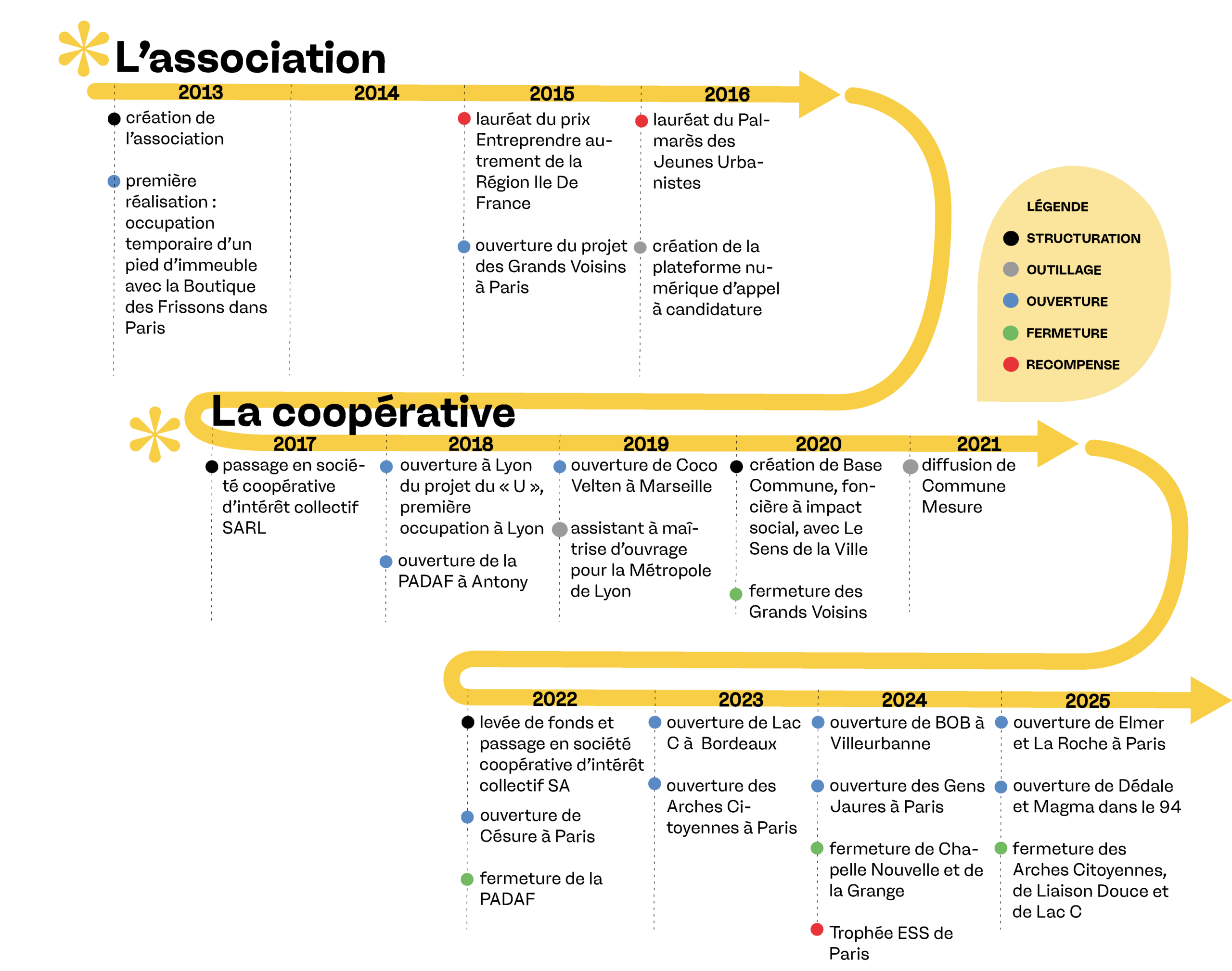
Key Dates in the Cooperative's History

In 2012, Simon Laisney, then a real estate analyst, was struck by the scale of the vacant office phenomenon in the Île-de-France region: up to 3.5 million square meters of unoccupied space, equivalent to about thirty Montparnasse Towers. Faced with this reality, he brought together stakeholders from urban planning, architecture, and real estate to envision new uses for these unused spaces.

In 2013, this collective effort gave rise to the association Plateau Urbain. The goal was clear: to build bridges between the real estate sector and the worlds of artists, organizations, and innovators, in order to transform vacant spaces into venues for experimentation and creativity.

That same year, the first temporary occupation took shape with the Boutique des Frissons, set up in the ground floor of a Parisian building. This initial project laid the groundwork for an approach that would become Plateau Urbain’s signature: activating vacant spaces to support social, cultural, and community-driven projects.
In 2015, Plateau Urbain reached a major milestone with Les Grands Voisins, a large-scale temporary occupation project set up in the former Saint-Vincent-de-Paul Hospital in Paris, carried out in partnership with Aurore and Yes We Camp. This iconic site became an urban laboratory combining social housing, artist studios, community organizations, and cultural activities.

This period also marked growing recognition: Plateau Urbain received the “Entreprendre autrement” award from the Île-de-France Region in 2015, and was honored in the “Palmarès des Jeunes Urbanistes” in 2016. The cooperative also launched its digital platform for calls for applications, facilitating access to spaces for project leaders.

In 2017, the organization reached a milestone by becoming a Société Coopérative d’Intérêt Collectif (SCIC). This change in status reflects a commitment to sharing governance among the various stakeholders and to embedding the project sustainably within a cooperative framework.

Starting in 2018, Plateau Urbain began its national expansion. New projects emerged in Lyon, with the launch of the “U” project, and then in Antony with the PADAF space. Transitional urban planning became a tool for temporarily transforming vacant buildings into spaces for work, creativity, and social innovation.

In 2019, the cooperative participated in the opening of Coco Velten in Marseille, an iconic project combining social housing with economic and cultural activities. That same year, Plateau Urbain expanded its expertise by supporting local governments, notably through a project management assistance mission for the Lyon Metropolis.

In 2020, the cooperative continued to innovate with the creation of Base Commune, a social-impact real estate entity developed with Le Sens de la Ville, aimed at securing spaces for community-oriented uses. This year also marked the closure of Les Grands Voisins, following several years of experimentation that profoundly shaped transitional urbanism in France.

In 2021, Plateau Urbain developed Commune Mesure, a tool designed to analyze the social, economic, and territorial impact of temporary occupation projects. This tool helps to better understand and highlight the effects of transitional urbanism on cities and their residents.

The year 2022 marks a major turning point: the cooperative transitions into an SCIC SA, opening membership to occupants and strengthening its democratic model. A significant fundraising effort also enables it to expand its capacity for action, particularly to support large-scale projects such as Césure, a third place located on a former university campus in Paris.

In 2023, Plateau Urbain celebrates its 10th anniversary. This year also sees the opening of new spaces such as Lac C in Bordeaux and Les Arches Citoyennes in Paris, continuing the mission to transform vacant buildings into open, creative, and community-oriented spaces.

Starting in 2024, the cooperative continued to expand with new openings, notably BOB in Villeurbanne and Les Gens Jaurès in Paris, while continuing to adapt its projects to the rhythm of urban cycles. This year was also marked by the cooperative’s receipt of the Paris Social and Solidarity Economy Award, recognizing the social impact of its model.

In 2025, Plateau Urbain opens several new spaces, including Elmer and La Roche in Paris, as well as Dédale and Magma in Val-de-Marne. At the same time, some projects come to an end, illustrating the temporary and evolving nature of these urban occupations.

For over a decade, Plateau Urbain has thus pursued its goal: to reveal the potential of vacant spaces and enable social, cultural, and economic initiatives to take root there, helping to create cities that are more inclusive, open, and experimental.

How the cooperative works

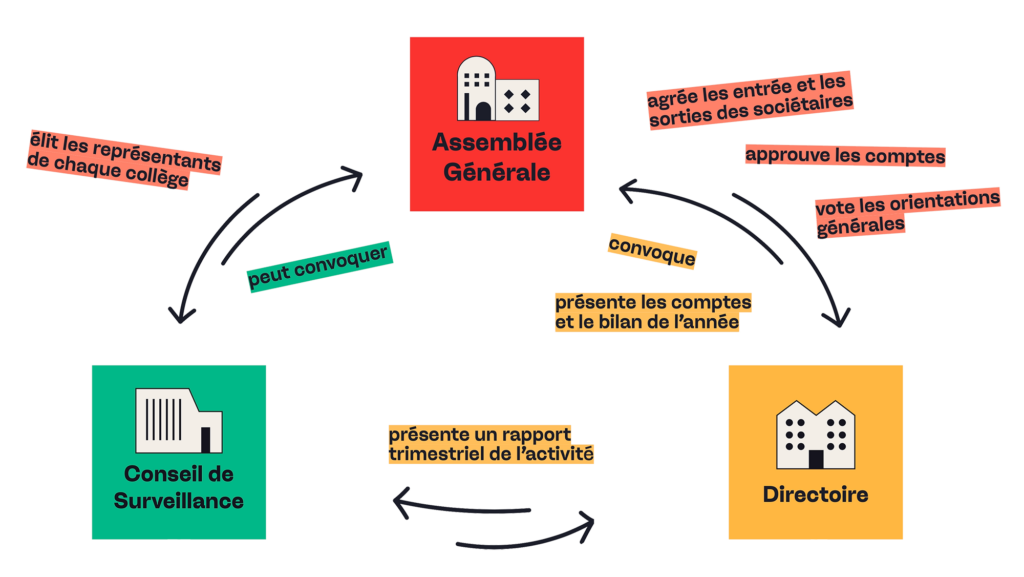
The Plateau Urbain cooperative has a three-tier governance structure:

The general meeting is composed of all members. Its primary roles include approving the annual activity report and the cooperative’s financial statements, setting its general policy, amending its bylaws, and admitting new members.

Learn more about members

The supervisory board is the cooperative’s governing body. It consists of 12 members, elected by the general assembly and representing various categories of members: residents, experts, employees, partners, and financial supporters.                  

The Executive Board is the cooperative’s governing body. It is responsible for implementing the decisions of the General Assembly and the recommendations of the Supervisory Board. The Executive Board consists of three members: Simon Laisney, Angèle de Lamberterie, and Mathias Rouet.

There are currently five membership categories, which come together at the General Meetings.

EMPLOYEES

weighted vote

0 %

EXPERTS

weighted vote

0 %

PARTNERS

weighted vote

0 %

FINANCIAL AID

weighted vote

0 %

RESIDENTS

weighted vote

0 %

A cooperative dedicated to transitional urban planning

Plateau Urbain is a cooperative dedicated to transitional urban planning. This approach involves temporarily occupying vacant urban spaces in order to test them and explore their potential future uses. It aims to revitalize these areas, make them more attractive, and foster community-led initiatives, while providing affordable office space to those who need it.

The cooperative is committed to:

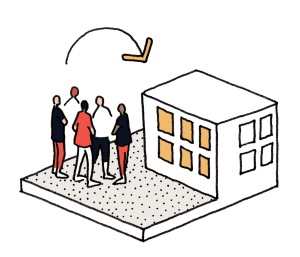
Defending
the right to the city

Illustration, défendre le droit à la ville | Plateau Urbain
by enabling everyone to use and take ownership of vacant urban spaces and by working in close cooperation with property owners.

Giving new purpose to unused spaces

Illustration, redonner une utilité à des espaces non occupés | Plateau Urbain
over a given period (18 months to 6 years), offering them primarily to organizations in the cultural and arts sector, the social and solidarity economy, and the nonprofit sector.

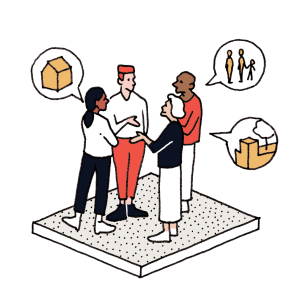
Promote diversity in land use and demographics

Illustration, promouvoir la mixité des usages et des profils | Plateau Urbain
by creating spaces that combine emergency housing with vocational activities, thereby promoting inclusion and fostering a lasting social impact.
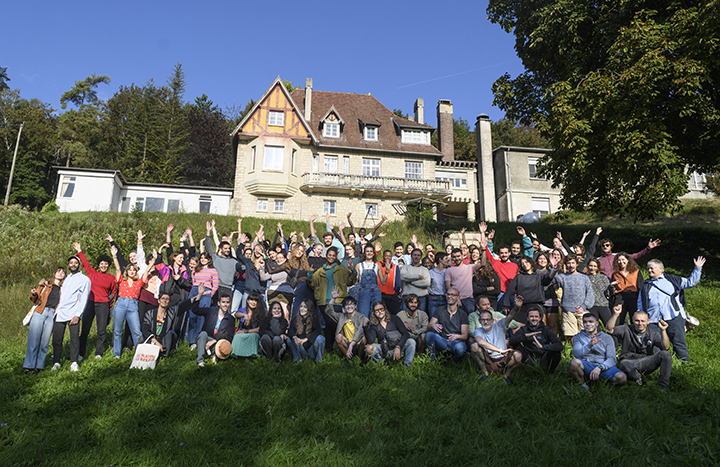
Photo de groupe mains levées - Toutes les équipes de Plateau urbain en séminaire à Autrêches, à l'Hermitage Lab en 2023.

The teams

Plateau Urbain now has nearly 100 employees who work every day to make the city more accessible and welcoming. They are divided into five departments with diverse and complementary roles: the Research Department, the Development Department, the Technical Department, the Operations Department, the Communications Department, and the Support Department.

«

Since its founding in 2013, Plateau Urbain has been:

more than 59 temporary leases,
with rents per square meter averaging between 30% and 70% below market rates.

more than 2,500 organizations that lack the financial means to access the conventional real estate market, housed in more than

278,000 m².

more than 2,000 people in precarious situations who have received emergency shelter at about ten mixed-use sites co-managed with community organizations

Online resources to help you understand better

In the interest of transparency, we are posting as many documents as possible online to help you understand the cooperative and share knowledge about new approaches to the line: activity reports, surveys, informational brochures, press releases, and more. Feel free to browse or download them!

Abonnez-vous à la newsletter
de Plateau Urbain